Showing posts with label Novel. Show all posts

Thursday, May 17, 2012

DVD Review:Norman Mailer: The American


It would probably be impossible to make an uninteresting documentary about the life of Norman Mailer, director Joe Mantegna's Norman Mailer: The American is not interesting.   It is absolutely fascinating.  Relying on a wealth of film of the never camera shy author himself interwoven with revealing commentary from wives and lovers, friends and enemies, he creates a  warts and all portrait of a complex man who at times managed to be a writer of genius, at times an egomaniacal reprobate.  For all his flaws, and there were many of them, he had the kind of personality that could infatuate some, infuriate others.  Those that loved him seemed to love him no matter what he might do; for those that hated him, he could do nothing worthwhile.

Mantegna begins with some information about Mailer's parents, his childhood, and even his early writing success with a prize winning short story while at Harvard, but the real focus of the film is the prominence that he achieved with his debut novel The Naked and the Dead, a book many people still consider his finest piece of work and his life and work until his death in 2007.  This is a man who had six wives, nine children, and who knows how many mistresses.  This is a man who managed to get a murderer freed from prison only to have him murder again, a who man stabbed his second wife and persuaded her not to press charges, a man who marched on Washington to end the Viet Nam War, and can be seen in a movie doing his best to bite off Rip Torn's ear.

There is a good deal about Mailer's writing.  "Why do I write?"  He has said: "Why did I start to write?  Because it was the only thing I was good at and I wanted to be more attractive to the girls." That's Mailer at his best, a little false modesty, a bit of a wink, and you know damn well he doesn't mean a word of it.  The critical failure of the novels he wrote after the phenomenal success of his first book left him seriously depressed.  He turned to journalism and non-fiction and in effect invented his own new genre for his reportage--History as a Novel/The Novel as History, creative non-fiction. He wrote about people and he wrote about events.  Eventually he returned to the novel, and once a again found acclaim. He won two Pulitzer Prizes and was still writing up to his death.  This is not a man who took his craft casually.

There is a good deal about his personal life.  His sexual peccadilloes are trotted out with gusto.  His brawls, both physical and intellectual, are itemized with special emphasis on the film of the fight with Torn and the contretemps with Gore Vidal on Dick Cavett's TV show.  His career as a political provocateur, from his anti-war activities to his race for mayor in New York, is illustrated.  He is shown in the context of the sweeping societal changes that were shaping the country in the latter half of the 20th century.  The major figures and events of the period, whether the presidency of LBJ or the emergence of Muhammad Ali, are always cited to provide the background needed to understand how the times helped to make the man.

There are touching moments.  Mailer looks back on a copy of his bar mitzvah speech. His wife Adele reads from a letter he sent from the Pacific during the war.  There are moments that make you cringe.  His wife describes the crude language he used where his mother was bound to hear.  There is film of screaming quarrels with his fourth wife.  He can be witty and urbane.  He can be gross and boorish, but he can never be boring, and neither can any decent documentary of his life.  Montegna hasn't merely brought the man to the screen, he has brought him to life.

Cinema Libre's DVD runs 85 minutes.  Bonus features include the film's trailer, a gallery of letters from Mailer to his wife Adele, and some further interview material with Mailer. 
This article was first published at Blogcritics

Thursday, September 8, 2011

Book Review: All Our Worldly Goods


Article first published as Book Review: All Our Worldly Goods by Irene Nemirovsky on Blogcritics.

After the tremendously successful publication of Irene Némirovsky's posthumously discovered Suite Française, and despite charges of self-hating anti-Semitism in her portrait of the money grubbing business man in Daniel Golder, there has been a renewed interest in getting more of her work out in this country. In 2007 Fire in the Blood, which she was working on when she died in Auschwitz became available, and in 2010 a collection of her stories, Dimanche and Other Stories was published. And now comes another of her novels, All Our Worldly Goods, published in France in 1947, five years after her death and for the first time in this country.

The novel is a shorter version of one of those multi-generational multi-volume family sagas that were a staple of European fiction through the first half of the 20th century. Némirovsky manages to pack as much melodramatic action into her 250 odd pages as some authors got into their three volumes. There are young lovers agreeing to marry against the wishes of their parents, a broken engagement and a vindictive heiress, an attempted suicide, an autocratic patriarch, and all of this is set around two of the cataclysmic events of the era, World War I and World War II.

The essence of the book is the examination of bourgeois values in a changing society and under the duress modern warfare. It begins with a kind of sepia view of the old values with two families on a beach watching fireworks and a day later the two warring matriarchs riding out to swim in a horse drawn bath cabin. It is a world where parents tell their children what to do and the children do what they're told. It is a world where convention rules and everyone understands their place and what is expected of them, but it is a world on the verge of change. Young people have minds of their own. They don't feel the same kinds of obligation to family, to business, to the social status quo, and their rebelliousness is only increased by the horrendous conflicts reordering their world. It is not as though Némirovsky entirely rejects old world values, in the end there remain those like the responsibility the upper classes feel to set an example for those beneath them and the duty to one's family and country.

In what is a kind of foreshadowing of the epic civilian refugee's retreat from the advancing German army's invasion of Paris during the second World War in Suite Français, Némirovsky has two refugee marches to deal with, although neither with quite the same panoramic overview. Here the author's interest is much more focused on the central characters and their struggles. There are those who no matter what the catastrophe are concerned only with their worldly goods and there are those who rise above those concerns. There are those who can watch the world around them erupting and still dwell on their petty jealousies and there are those who can put the past behind them. There are those who give in to adversity and those who have the spirit to keep fighting. As one of the characters observes, people draw strength from misfortune, the greater the misfortune, the greater the strength.

Némirovsky is a compelling story teller. She rarely gets bogged down in irrelevancies. She has no problem jumping ahead a year or two to move her story apace. The important thing is to avoid burying the significant moments in a mass of trivia, and she manages this with consummate skill. She is adept at analyzing the emotional states of her characters caught in moments of personal crisis even when their world is falling apart around them. All Our Worldly Goods is as richly textured and layered with meaning as many a much longer work.

Wednesday, May 25, 2011

Graphic Novel Review: The Three Musketeers, by Alexandre Dumas

Article first published as Graphic Novel Review: The Three Musketeers by Alexandre Dumas, adapted by Bruce Buchanan, illlustrated by Amit Tayal on Blogcritics.

Alexandre Dumas' timeless adventure romance, The Three Musketeers, is now available in a graphic novel adaptation from Campfire Classics. With a text by Bruce Buchanan and illustrations by Amit Tayal, Dumas epic tale of love, treachery and intrigue in the court of Louis XIII is whittled down from more than six hundred pages in some translations to a sixth of that length, a more palatable length for the young adult audience the Campfire series targets. More importantly, the major elements of the story are intact.

Beginning with the young hero, d'Artagnan's arrival in Paris and his accidental contre temps with the eponymous three musketeers which promise him three duels with some of the best swordsmen in France and his eventual acceptance into the musketeers, the story follows him in his quest to save the Queen from the machinations of the villainous Prime Minisiter, Cardinal Richelieu and his lovely accomplice, Milady. It is a story that moves with as fast a pace as any summer blockbuster. It is a tale that has captured youthful imaginations for many years and is sure to continue doing so for many more.

Its characters are larger than life. Athos, Porthos and Aramis are the avatars of the hard living, devil may care swashbucklers that have become the staples of the modern adventure story. Richelieu is as slimey a political schemer as has graced the pages of any current thriller. Milady is the model of evil embodied in beauty. D'Artagnan is the naïf fresh out of the country meeting with the wicked temptations of the larger world, and demonstrating how innocent goodness can overcome all obstacles and get the best of the evil sophisticates.

Unfortunately, Amit Tayal's versions of the characters, unlike other Campfire editions I've seen, are more like Disney caricatures than the grittier norm. D'Artagnan is drawn in the tradition of characters like Pecos Bill and other Disney young innocents, only a bit more on the angular side. There are the big round good guys like Athos and the big round bad guys like the landlord Bonancieux. There are a lot of funny mustaches. The faithful Constance could have been a Disney princess if she had a fancier costume. Milady, of course, but even the evil Richelieu, both have overtones of the evil Disney queens. There are even a couple of cats putting in an appearance in a panel or two that wouldn't find themselves out of place in a Disney cartoon. I don't know that all this is necessarily a bad thing given the target audience, although I do think the grittier illustration might be more appropriate for the content.

A word or two about the content: some parents may find elements of the story unsuitable for young readers. Adultery and infidelity play a large role in the motivation of the action, and although the adaptation minimizes the sexuality of the narrative, it is impossible to eliminate it entirely. Certainly while there is nothing overt in the presentation of the material, and what is there will more than likely go over the head of most youngsters, parents might want to look it over to see if they have any objections.

Like other Campfire editions, The Three Musketeers begins with a short biographical sketch of the author. There is an introductory page with illustrations of all the major characters. An appendix containing miscellaneous information related to the story and its contents closes the book. In this case there is information on things like the historical novel, the historical characters, and the term musketeer. It provides a little fodder for any child whose appetite has been piqued by the story.

Saturday, May 7, 2011

Book Review: The Diviners, by Rick Moody

This article was first published at The Compulsive Reader.

In an interview on National Public Radio, Rick Moody describes the structure of his latest novel, "The Diviners," as modeled on that of serial television with perhaps a touch of the eighteenth century British novelist, Laurence Sterne. From serial television he seems to have taken the idea of following multiple characters, whose own stories are directly or indirectly connected to one or more major plot lines. From Sterne he has taken the passion for the digression which often emphasizes the meandering branch over the narrative stream from which it wanders.

What he has produced in "The Diviners" is a loosely structured panoramic vision of the beginning of the American twenty first century told from the points of view of a large and varied cast of characters. Some speak once and are never heard from again. Some appear once, speak their piece and then step back onto the canvas to emerge again sporadically in the narrative of others. A few, those more central to the major plot lines, speak several times and pop up on a fairly regular basis when others narrate. It is a cast of, if not thousands, enough so that at times it is not always easy for the reader to keep track of them all.

Moody draws his characters from a broad spectrum of contemporary American society, each in some way representative, each in some way unique and individual. There is the Italian mother who wants to see her only daughter married and who hides bottles of a malt beverage in her bathroom. There is the Sikh car service driver with an autistic son, a degree in European fiction and a passion for western television. There is the liberal Massachusetts clergyman who adopts Afro-American children, falls asleep during television shows and drunkenly lusts after the sixteen year old daughter of one of his parishioners. There is the Chinese art curator who sees the world dimly through the veil of a head injury, the rebellious middle class teenager who hooks up with a group of terrorist ‘wannabees,’ the middle age accountant who turns embezzler to help her new found boy friend out of his own financial difficulties–and these are just a few of the many voices in Moody’s chorus.

Although usually in the third person, each speaks in a voice distinctly his own. The Sikh: "They eat the snack called french fries. His son has an abiding need to put french fries into the mouths of everyone present. Even some strangers are willing to have these french fries put into their mouths." The Italian mother: "She will need someone from the neighborhood to keep an eye on her parking space. She has no car, but still. People are moving in, young people, they don’t even know." The Chinese art curator: "Everyone seems very happy to see her in the wheelchair. She is the sort of person whom people are very happy to see out in the hall. People actually stare at her, which reminds her that she should know what she looks like."

Voices blend with one another to sing Moody’s chorale–a richly comic, satiric commentary on this American life. Set mostly in New York City in the days just after the contested presidential election of 2000, the main plot centers on an independent film company, Means of Production, and its attempt to get into mainstream television by pitching an non-existent mini-series script about water diviners. This is complimented by a secondary plot about a bipolar bike messenger accused of assault. But often as in "Tristram Shandy," the most famous novel by Laurence Sterne, the plot is almost secondary to the odd bits and pieces that grow out of it and wind their way around it. While Moody never strays quite as far from his story as Sterne does from his, it is nonetheless clear that plot is not the major focus of this novel.

Rather it is the arid desert of Western culture as it moves like the light moving westward and threatening to engulf all that it meets until it comes back upon itself that is the real concern of the novel. "The Diviners" is supposedly a series about finding water, water to assuage the thirst of mankind throughout the ages, from the Huns to Las Vegas. Thirst is a metaphor for the spiritual emptiness that is endemic to this cultural desert in which we now live. Television, the entertainment industry, is simply the most strident example of that spiritual vacuity: mindless action movies aimed at teenage boys, glitzy quiz shows to watch during dinner, unreal reality shows where back biting strangers scheme to vote each other off some tropical less than paradise.

This kind of aesthetically barren entertainment is a kind of overwhelming force in the world that Moody describes, but even in popular art the germ of something more meaningful may be found. In a bravura passage late in the novel, he describes in detail the Thanksgiving episode of what is the most popular dramatic series on TV–"The Werewolves of Fairfield County." It is a story that combines alienation from the larger society with a sense of unity within a smaller unit. That the alienated are werewolves and that the smaller unit is the pack is indicative of the nature of its social commentary. Nonetheless, what the newly sprouted werewolf must learn is that though he is separated from what is the ‘normal’ society, he will always be able to rely on the other members of the pack. Significantly almost every character in the novel seems to be tuned into the program, and their reactions are interspersed through the narrative account. It is as though the whole country is tuned in. There is a message and there is, it seems, an audience for that message.

If the entertainment industry with its vertical corporate structure and its anorexic teenage divas strung out on drugs, its pandering producers and its ambitious assistants waiting breathlessly for that one false step is the central object of Moody’s satire and comedy, it is not the only one. All areas of modern civilization or lack thereof are fair game for his wit. Randall Tork is "the greatest writer in wine history," famous for the column in which he compares 1997 California chardonnays to an actress: "These wines are flabby in the way the cellulite bulges from the too-tight pouches of her nulliparous behind. . . ." Eduardo Alcott is a faux revolutionary who seems obsessed with the "ancient surgery of trepanation" as a cure for migraines as well as a source of more general feelings of well being. The fragment of skull to be removed, he opines, can be made into an amulet. Arnie Lovitz is a middle aged accountant who sets up fictitious corporations on Caribbean islands, islands that sometimes don’t even exist. There are the New York detectives who follow their suspects into trendy restaurants so they can order fancy lunches, support groups for food addiction, sexual liaisons masquerading as yoga lessons, rehab hospitals that have trouble keeping track of patients, botox parties and romance novelists who don’t bother to write their own books. There is even a fifty dollar guided tour to the desert scene of an alien abduction.

Moody is an equal opportunity satirist. He moves up and down the social ladder. He pokes fun at a variety of races, sexual orientations and political affiliations. Sometimes his mood is gentle as with a senior citizen messenger who likes to talk baseball with his deliveries; sometimes his touch is more biting as with the philandering action movie star who doesn’t mind a little pain with his sex. He can be laugh out loud funny as he writes about his overweight heroines wild binge through each and every one of the island of Manhattan’s Krispy Kreme franchises. He can be subtle and understated as he hints at some hidden desires of a nameless supreme court justice and a special friend he hasn’t seen for years.

At times he indulges in virtuoso cadenzas on a variety of themes. The book begins with a lengthy rhapsody on the westward movement of light. There is a long passage in which Ranjeet, the Sikh driver discourses on the significance of the picture as an aesthetic force and its application to motion pictures an television to conclude that the avatar of American story telling art is "Roots:" ". . .all American stories aspire to this condition, which is the condition of the saga. All stories aspire in this direction, and all corporations aspire toward the sale and reproduction of this saga. Nothing could be more American than this, and nothing could be more international than what is American, nothing could be more human; there are no nationalities, there are only ethnicities and corporations, there is only the military and its collateral damage, and the land of profitability and cowboys and slave trading." There are the almost rapturous riffs on the Krispy Kreme doughnut: "The great spiritual benefit of the Krispy Kreme original glazed doughnut is the sensation of nothingness. The satori that is Krispy Kreme is the obliteration of self, the silencing of the voices that are attached to the oppressions of life."

Throughout he weaves pop culture references with academic allusions–Regis Philbin and Michel Foucault, "Nightmare on Elm Street" and semiotics, non-euclidean geometry and Bob Dylan. He skewers the nonsense that fills the lives of many people, those who fancy themselves intellectuals and those who have no such illusions about themselves. There are those who produce the products of Western culture. There are those who consume those products. There are those who analyze and critique those products. But when you come right down to it, whether you produce or consume, whether you attack, explain or extol, there is really no escape from its spiritual emptiness.

"The Diviners" is a funny book. You can’t help laughing at its humor, still, underneath that laughter–as with all great humor–there is something much more serious. It is a book that takes a hard look at us and the world we live in, the things we like and those we want no part of. It is a book that suggests that a civilization that privileges a pastry that gives the "sensation of nothingness" is in danger of achieving that same nothingness, itself.

Monday, February 28, 2011

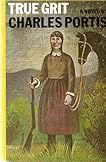
True GritTrue Grit by Charles Portis

My rating: 4 of 5 stars


Although the narrator is an older woman at the time she is telling the story, she more often than not steps back into her young girl persona. Every once in awhile she speaks in her older voice, when she moralizes about events. While this takes some of the uncertainty about her fate, (since it is a first person account we are assured of her safe return, if not the specifics), it does provide perspective on the events.


View all my reviews

Wednesday, September 8, 2010

The Imperfectionists: What is a Novel

This article was first published at Blogcritics

Tom Rachman's debut novel, The Imperfectionists, has been one of the most hyped books of the year. That it is an engrossing read is unquestionable, but whether it should be considered a novel, on the other hand, is open to some debate. The book is a collection of short stories all connected by the characters' affiliation with an English language newspaper operating in Rome. One is a freelance Paris correspondent at the end of his career. Another is the obituary writer and editor of the puzzle page. There is the current publisher, the editor in chief and the chief financial officer, not very affectionately known as "Accounts Payable." Characters central in one story are sometimes mentioned in others, but for the most part each story most often deals with the protagonist's personal life and stands alone.

There are certainly thematic connections: the central figures are certainly "imperfectionists." There are older men with problems with younger women. There are lonely women demeaning themselves for faux romance. There are people who are unable to adapt to the demands of the new media environment. Moreover they are all attached to a central spine between stories detailing the history of the newspaper (modeled on the International Herald Tribune), much in the way individual stories are connected in such classics as The Canterbury Tales and Boccaccio's Decameron. These are two or three page glimpses into significant dates in the paper's history: its inception, the hiring of new blood, the changes in the publishing family.

The nice thing about this kind of structure is that if you find one story and its characters not to your taste, there is always going to be another one you may like better. The problem is that the stories that don't interest you may get in the way of those that do. Advantage or disadvantage, is a work of fiction structured in this way really something that should be called a novel?

If by novel you mean a long work of prose fiction, it most certainly is a novel. If, on the other hand, a novel is a long work of fiction with a central through line that unifies the whole, then perhaps you need some other kind of generic marker for Rachman's book. One thinks of other works of fiction that collect shorter pieces with some common theme: James Joyce's Dubliners for example, Sherwood Anderson's Winesburg, Ohio. These are collections with even subtler connections than Rachman's that have been sometimes characterized as novels, although most often they have been treated as short story collections. On the other hand, a large scale work like John Dos Passos' U.S.A. that not only tells multiple stories, often stories that have few, if any, connections, but also includes a number of other narrative elements, is usually thought of as a novel.

The novel as a genre has always been difficult to define. From its beginnings, wherever they might be marked, there have always been works that have defied classification for one reason or another: Gulliver's Travels, most of the fiction of Daniel Defoe, Rablais—the list could go on and on. Almost from its very inception, the novel has been a form that has given reign to experimentation of one sort or another, and perhaps this has been its greatest strength. Experimentation can allow the form to meet the needs and tastes of new generations of readers. A generation with an attention span accustomed to the sound bite, flash fiction and the ten minute play may well find they prefer their novels chopped into shorter pieces that can be digested in parts.

Whatever you call it, The Imperfectionists is well wrought piece of fiction deserving of all the accolades it has received. Whether it is a harbinger for the future of fiction remains to be seen.

Tuesday, March 16, 2010

Mini Review

Up in Honey's Room Up in Honey's Room by Elmore Leonard


My rating: 2 of 5 stars
Set in Detroit at the end of WWII: German spies, American symathizers, escaped prisoners of war, perky better dress sales woman, Okie Marshall, this is part of the large cast for this comic take on inept Germans. Too many characters, some get lost by the wayside, but character is not the main thing here. Leonard is having a little fun with the master race, and pointing out the superiority of down home grits and greens.

View all my reviews >>

Thursday, December 17, 2009

Mini Review: Undiscovered Country

Lin Enger's Undiscovered Country uses Shakespeare's Hamlet as an archetypal template for a modern story about a sixteen year old Minnesota boy whose father seems to have committed suicide, but whose ghost appears to accuse his uncle of murder. The boy, like Hamlet, seeks revenge, but finds it not as easy as it looks. There is a questionable relationship between the uncle and the boy's mother. There is an Ophelia character, with a mean spirited father. There is a visit to a psychiatrist. The novel doesn't have the ending of the play, but you now that from the beginning because the narrative voice is that of the Hamlet figure.

Monday, November 23, 2009

Book Review: How to Paint a Dead Man by Sarah Hall

Some novelists preach and pontificate about life and art. They speak directly and with assurance. Some novelists explore and imply. They speak indirectly. They speak through metaphor and suggestion. As the poet Robert Browning says, they "do the thing shall breed the thought." How to Paint a Dead Man is a novel that does the thing that breeds the thought. It is a complex book that teases the reader from page to page with the promise of great truths, and when it delivers those truths, it does so with the ambiguity to which all great thought should be entitled.

Sarah Hall weaves together what at first appear to be four very separate stories. They seem to have very little to do with one another. They are narrated through different points of view. They take place in two different countries, England and Italy. Each of the four is set in a different time period. Only gradually, is the reader made aware of connections between the stories. The speaker in one turns out to be the daughter of another. An Italian still life painter who narrates one story tutors a grade school class in painting, and the central figure in another is one of his students. In the end it turns out that there are relations between the characters in all of the stories.

More importantly, all the central figures are, in one way or another, artists. An interviewer questioning the author about the fact that two of the characters were artists provoked her to protest that, in fact, all of the central figures were artists. Two of them, the interviewer's artists, are painters, one, Giorgio, of still lives; the other Peter Caldicutt, a landscape painter. But Hall admonishes, of the other two, Susan Caldicutt is a photographer, and Annette Tambroni is a flower arranger.

"The Mirror Crisis," which begins the novel is narrated in the second person, an unusual point of view to say the least, and in the voice of Susan Caldicutt. She is a fraternal twin, and she has just learned that her brother has been killed in a traffic accident. Besides, being a promising photographer, she is also a curator working in a London art gallery. Her brother's death is devastating, not only as one would expect any death of a family member to be, but because they have as twins been two parts of whole. His death in some sense destroys her as well. One might be forgiven for thinking of Madeline and Roderick Usher.

"Translated From the Bottle Journals" is a first person account of Giorgio an Italian painter modeled on the painter Giorgio Morandi. He is dying of cancer as he tries to complete a last painting, a still life arrangement of bottles. He is very much concerned with explaining the relationship between his art and life, to make clear that still life, is still life—keeping in mind that still has more than one meaning. "The Fool on the Hill" is told in the third person from the point of view of landscape painter, Peter Caldicutt, Susan's father. He comes from a working class background and is fond of inventing a Bohemian past for himself, especially for his children. He couple this with a continuing flaunting of convention.

The last of the four interwoven threads is "The Divine Vision of Annette Tambroni." It is narrated in the third person in the voice of Annette, a young blind girl who lives with her mother, two brothers, and an uncle and sells flowers in the village market. Although sightless, her other senses have developed to the point where she is quite capable of "seeing," seeing especially that which may not be visible to those with sight. This is no doubt the divinity of her vision. One is invited to remember all Annette's literary forbears who found in blindness the ability to see.

These characters and their stories are the bones of the novel. The heart is in their thoughts and emotions as they struggle to understand themselves and their relation to the other, to deal with the essential isolation of each individual: "Inside solitude people see the many compartments of unhappiness, like the comb of a pomegranate." Indeed, objects speak more clearly to these people than do other people. Giorgio maintains that only when he can make Peter understand "the timeless gifts of nature morte," will he begin to understand "living art." Examples of nature morte" are the objects in still life paintings. Peter finds that the rocks on the mountains are alive; he wonders if they are out to get him. Objects begin to speak to the blind Annette.

Truth is in the object. When people talk, too often truth disappears in the noise, so that even when they mean to tell the truth no one can hear it. Peter has told so many tall tales of his younger days, that when he tries to give Susan one of Giorgio's bottles, she won't believe it is really his. When he needs help, no one can hear his cries. Annette's mother cannot protect her with constant admonishments to be careful. Annette finds it impossible to explain her fears about the beast she feels around her.

On the other hand: "The kestrel achieves perfection in stillness."

Still, one may not want to lay such a heavy burden on art and the artist. This is perhaps the significance of the novel's title. How to Paint a Dead Man comes from The Craftsman's Handbook by Cennino d'Andrea Cennini where he gives the aspiring artist instructions on how to paint a dead man. Giorgio parses this passage: "I have often wondered if the condition of death is perhaps less grave to the human anatomy than physical injuries. For in death there is release from suffering. Sadly, the master craftsman is unable to instruct us in the healing of wounds."