Monday, June 11, 2012

Music Review: Cynthia Felton - Freedom Jazz Dance

This article was first published at Blogcritics

The first time you hear Freedom Jazz Dance, the latest album from Cynthia Felton you will be impressed by the purity of her vocals and her command of the jazz idiom. The more you listen, the more impressed you will be. This is a vocalist steeped in tradition.  She understands the contributions of the ladies of past generations, and she understands the need to build upon them.  She understands that the true artist needs to find her own voice. And if Freedom Jazz Dance is any indication she has found it, and jazz fans are going to be very glad she has.

The album's 12 tracks, she tells us in the liner notes, are a "collection of my favorite standards to sing."  It won't take long for them to become a collection of your favorite standards to listen to.  She starts with an impassioned a cappella version of the spiritual "Oh Freedom" in a nod to the gospel roots of jazz, before morphing into innovative takes on the Paul Desmond, Dave Brubeck classic "Take Five" and the Rogers and Hart perennial "My Funny Valentine." "Take Five" features some nice tenor sax work from Ernie Watts, and "Valentine" opens with the solo trumpet of Wallace Roney and features some interesting bass 'improv' from Robert Hurst.  A variety of different musicians accompany the singer on the various tracks.

"Better Than Anything" is one of the less well known pieces on the disc; it gives the singer the opportunity to swing the blues and add a little scat. Cyrus Chestnut adds a sweet piano solo and Nolan Shaheed is on the trumpet. "My Love Is" and Charles Mingus's "Duke Ellington's Sound of Love" two more less familiar tunes follow, and Felton's performance has to make you wonder why they aren't heard more often. 

"Close Your Eyes" opens lullaby-like with Hurst's bass and Felton's soft vocal, before she begins to swing with a straight ahead vibel leading to a guitar solo from Ronald Muldrow, and some additional scatting.  The old Nat 'King' Cole hit "Nature Boy" gets a little Latin American vibe from Felton. Patrice Rushen handles the piano and Terri Lyne Carrington the drums. Felton comes in at the end and wails to a dynamite climax.  It is one of the album's many highlights. The Kurt Weill classic ballad "Lost in the Stars" gets a dynamic treatment from Felton.  This is followed by a wild romp through Ray Noble's "Cherokee" accompanied by Edwin Livingston's bass and Nolan Shaheed's trumpet.  The Bergman Legrand ballad "What Are you Doing the Rest of Your Life?" follows and the album ends with its title song, "Freedom Jazz Dance." The first gets an eloquent atmospheric treatment from the singer; the second is a rhythmic celebration with some strong piano solo work from John Beasley. Lorca Hart drives it forward on the drums.  It is a real tour de force.

Cynthia Felton's Freedom Jazz Dance is as fine a jazz album as you're likely to come across for the rest of the year.  She is the kind of singer that can take a great song and make it her own.  Listen to her version of "Cherokee," and if it isn't heresy, it may well make you forget Charlie Barnett.  Her "Nature Boy" will give the 'King' a run for his money.

Saturday, June 2, 2012

Music Review: Rachel Sage - Haunted By You

This article was first published at Blogcritics

Rachael Sage is not your run of the mill June/moon singer songwriter. You hear a line like "today is the first day of the rest of my. . .;" and if you're expecting the cliché, forget it, not going to happen. Sage is a poet. The ordinary image is not where she's going.  For her ideas and emotions, she needs "bittersweet Swarovski," "a big old purple sequin. . . tearing up" her art, "one speck of mica shining on the ground." In a lover's touch she hears the "Song of Solomon. She searches for meaning in a "dead sea of ill-fated dreaming." Without love you're "one mitten in Grand Central's lost and found."

Luckily, Sage's latest album Haunted by You comes complete with a full set of lyrics for the 12 original songs. You'll want them. Listening won't be enough, you'll want them in front of you to ponder while you listen and think about long after. Not that there's anything wrong with the music: she has created a passionate song cycle that plumbs the emotional depths of love found and love lost. “I fell recklessly in and out of love multiple times while writing this record," she explains on her website. "I broke a couple hearts…and I also had my heart broken pretty badly.” Broken hearts have long been the stuff of pop music; Sage's gift, and she has one, is to take "what oft was thought," as one poet past has put it, "but ne'er so well expressed."

Whether she's indulging in the kind of arcane allusions and metaphors reminiscent of the Metaphysical Poets—a lover's touch is a "Kabbalistic mystery," she can't be "the only Catherine wheel," or looking at love with a grittier eye—"I'm not just a girl you held one night in an Austin motel," there is an emotional honesty in her music that comes through clearly in her vocals. She is able to sell lyrics that might come across to some as esoteric or academic as expressions of sincere feelings. She can be vulnerable; she can be strong. She has her moments, at times hopeful, at times bleak, but always sung with truthful sensitivity. Always open about her own sexuality, some of the songs state it explicitly "Confession," "Abby Would You Wait;" most are generic expressions applicable to both sexes.

The album opens and closes with the paradoxically titled "Invisible Light," which highlights the desire for someone who really understands her. She calls it her favorite song on the album and points out how different the arrangements are. Dar Williams, Seth Glier and Joshua Leonard contribute background vocals on the reprise track. She says that "Abby Would You Wait" is about a long conversation shared one night after a show. Like "Invisible Light." It seems to be looking for that special understanding that binds two people. The cleverly titled "Soulstice" captures a moment of joy in passion, and the resignation that comes with the understanding that it is fleeting:  "Can't we just agree that I love you and call it a night." She is joined on the track by Kelly Halloran on violin, Jack Petruzelli on guitar, and David Immergluck on mandolin. 

Her own band The Sequins consists of Quinn (drums and percussion), Russ Johnson (trumpet and flugelhorn), and Dave Eggar (cello). Sage plays piano, wurlitzer, rhodes, harmonium, percussion and acoustic guitar.

"Haunted by You," the title song is one of a string of bleak laments on unrequited love, including "California," "The Sequin Song" (a metaphoric tour de force), and the truly black "Performance Art."   In "Confession," on the other hand, she takes the blame for love's failure on herself: "I took you for granted every day of my life."Contrast these with the artist's more hopeful expressions:  "Everything," for example, where "faith has a way of giving you what you need," and "Hey Nah," where she has "elected to be happy all" her days. "Birthday," while keeping to the cycle's central themes manages to throw in a little shout out the singer's Jewish roots, an indulgence she seems to relish both on the stage and on her website.

Tuesday, May 29, 2012

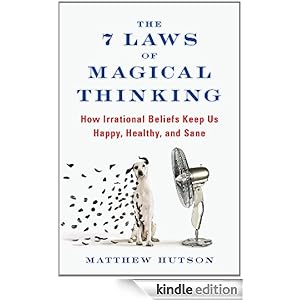
Book Review:The Seven Laws of Magical Thinking, by Matthew Hutson

This article was first published at Blogcritics


There would seem to be two salient points to be taken away from Matthew Hutson's explanation of what he calls The Seven Laws of Magical Thinking.  First of all you, I, we all engage in some if not all aspects of magical thinking, even those of us who would scream the loudest, "No way!"  Second, that it's a good thing.  Thus the tome's subtitle: How Irrational Beliefs Keep us Happy, Healthy, and Sane. 

Hutson begins by defining magical thinking.  "There's a world of the mind, defined by matter and deterministic forces.  But we instinctively treat the mind as though it had physical properties. . . . We perceive mind and matter mingling together, working on the same wavelength."  Magical thinking is the "mingling of psychological concepts with physical ones."  The book that follows is essentially a collection of examples and anecdotes illustrating the author's catalogue of seven different kinds of magical thinking.  The illustrations are drawn from history and current events; they are drawn from scientific experimentation and a few are even culled from the world of fiction.  Some of the examples are fascinating, some less so; some are convincing, some more of a stretch—but taken as a whole, Hutson makes his points forcefully and with wit. 

On the most obvious level he talks about things like the tendency of pet owners to endow their pets with human qualities and the belief that there are objects that can bring us good fortune or bad luck.  More controversial, especially to believers, would be the belief in a divine being that can exert control over human affairs or the ascription of emotions and feelings to the human fetus.  Somewhere between extremes, he suggests that the use of metaphoric comparisons like angry sea and raging storm indicate a kind of unconscious ingrained magical thinking.  In almost all cases he points to psychological experimentation which supports not only the idea that such magical thinking exists, but that it can in fact have significant positive value.  For example, he sites experiments that have demonstrated that people who attribute events to a divine agency are better able to deal with the evils that life throws their way. 

Perhaps the most interesting reading in the book is the least scientifically convincing and that is the anecdotal material.  In one of the earlier chapters in which he discusses the idea that physical objects have essences that can be transferred, he talks about the effects that people felt when the piano on which the assassinated Beatle, John Lennon, composed "Imagine" toured the country after his death.  People claimed that they could feel the man's presence in the piano.  There are the stories of hospital patients rehabbing with the aid of robotic pets and amputees who can still feel their lost limbs.  There is the story of the construction worker who tried to jinx the Yankees by burying a David Ortiz jersey in the concrete of their new stadium. The book is filled with these kinds of stories to dine out on.

The uses of such magical thinking are varied. It can help us deal with our fears of the unknown.  It can give us intimations of immortality and provide a rationale for altruistic actions.  It can help us to come to terms with our bodies and their often disgusting functions.  It can allow us to feel superior to fellow creatures.  One only has to think back to the 19th century Industrial Revolution to see how magical thinking persuaded many to believe that products made by the hand of a man were superior to those made by the new machines, because a man could infuse his work with his passion for what he does, while a machine could only manage sterile perfection.  Indeed imperfection, as in Ruskin's praise for the great Gothic cathedrals, was an indication of a building's greatness, because it was an indication of the human touch. 

"Whether magic exists or not," Hutson concludes, "magical thinking got us where we are, and for better or worse, it will take us where we're going.  We could no sooner escape it than we could escape consciousness.  We think, therefore we think magically."


Sunday, May 27, 2012

Comedy CD Review - Hannibal Buress - Animal Furnace

This article was first published at Blogcritics

Hannibal Buress is one funny guy.

His new CD Hannibal Buress: Animal Furnace, an extended and uncensored recording of his Comedy Central world premiere stand-up special is laugh out loud hilarious.  Whether he is talking about Meghan Fox scatting or jay walking in Canada, he has a real sense for life's absurdities. Sure he takes some shots at easy targets—the TSA, debit cards, but they are targets that deserve all the ridicule they get.  And even when he starts on masturbation, his take is at least something original.  Besides while his humor may be raunchy, it is really not mean spirited.  He looks at what goes on around him and asks can you believe this.  He doesn't quite say it that way, but that's what it amounts to.  His world is a nutty place, and he is a master at showing just how nutty it is.

He talks about the danger a comic might risk by of contacting one of your Facebook fan/friends on the road; he talks about men's health magazines and buying apple juice.  There is a story about late night in Edinburgh. He even manages laughs about lettuce (and there isn't any 'k' in lettuce). It is funny stuff, delivered sometimes with dry wit, sometimes with passion, but always with consummate skill.  Buress is a pro.

Given that the funniest bit in the set, for my money at any rate, is something he calls "Wack Writing," it takes some real nerve to write about Buress's comedy.  He reads some passages from an article written about one of his college shows and rips it to shreds. It's not that he is grousing about negative criticism, it is simply that he recognizes the nonsense and careless writing that too often passes for informed content, even when that content is meant positively.  It is a caution not to be taken lightly.  You have to be careful about what you say when writing about Buress, you might well find yourself taking up five minutes in his act and end up as the butt of a "comedic" joke. 

Comedy Central is also releasing a DVD of show which will also include some 20 minutes of material not in the original broadcast.  It features a behind-the-scenes documentary about how Buresss spent the week prior to filming the show.  Clips are available on the Comedy Central Stand­-up website. 

For anyone in the New York area, Buress will be headlining a Comedy Central Live Presents Hannibal Buress, a free live outdoor show which will also feature comics Kevin Barnet and Josh Rabinowitz.  The show is scheduled for June 24th at 7: 00 pm rain or shine at Red Hook Park in Brooklyn. 


Friday, May 25, 2012

Graphic Book Review:Zeus and the Rise of the Olympians

This article was first published at Blogcritics


Parents of superhero drenched comic book fans interested in introducing their children to something a little more culturally substantial may want to take a look at the latest volume from Campfire Graphic's Mythology series, Zeus and the Rise of the Olympians.  Much like the Classic Comics of old, Campfire's publications—novels, biographies, myths—hopefully build upon youngsters' interest in comic books to get them excited about more important literature.  Graphic versions of "the best that has been known and thought in the world" certainly can be one way to motivate interest in the original, and if they don't, well getting the story of Eros and Psyche or The Merchant of Venice from a graphic book, is clearly better than not getting it at all.

Taking the form of a teacher in ancient Greece telling her class the story of Zeus, Ryan Foley's version begins with the legend of the conquest of Ouranos by his son Chronus and the curse that Chronus will in turn be overthrown by his own child.  It describes how Zeus escapes the fate of his five siblings through the guile of Rhea and Gaea, and his eventual fulfilling the curse and imprisoning Chronus in Tartarus.  It is a story filled with fighting, treachery and monsters—much the kind of thing that should easily attract the imagination of any youngster enamored with the likes of Spiderman or the Green Goblin.  In fact, some parents may find it a bit too violent for their taste, so it would make sense to preview the material.  Violence is, of course, endemic to Greek mythology; still, this is not a book for young children.

Jayakrishnan's illustrations are in the best traditions of the superhero genre.  Comic readers will find themselves quite at home with his work.  His vision of the monsters in Pandemonium and Chaos at the very beginning is nightmarish, and his depictions of Brontes the Cyclops, the Hecatonchires (Hundred-handers), and Kampe (a she-dragon) are equally horrifying.  Truly it would be necessary to be a god like figure, if not a god yourself to defeat creatures of this sort.  The art work, often dark and grainy in some of the other Campfire editions, avoids the garish quality of some comics in favor of a grittier vision, a grit eminently suitable to the subject matter.

Like others in the Campfire series, Zeus and the Rise of the Olympiansbegins with a page introducing each of the major characters and ends with a page or two of general information on some topic that should be of interest to the young reader and perhaps spark further study.  In this case, there is some discussion of the Olympic Games, a bit about Greek architecture with examples from around the world, and some information about words derived from the Greek gods. 

Other books in the Campfire Mythology series that could be of interest are Stolen Hearts: The Love of Eros and Psyche. The Legend of Heracles, and Jason and the Argonauts. While there are some adaptations of mythological materials from other cultures in their catalogue I haven't yet seen them, but if they are as well done as the Greek myths, I would imagine they would warrant some attention.

Wednesday, May 23, 2012

Music Review: Willie Nelson - Heroes

This article was first published at Blogcritics

At the very end of an absolutely swinging version of the 1943 roots gem "Home in San Antone" on Willie Nelson's new album, Heroes, you can hear the singer add, "that's a great track." He's right, it is a great track, and if he had said it about the album as a whole, he would have been right as well.  In Heroes Willie, his sons and a friend or two have put together a compilation of some things old and some things new and produced themselves one great album.  But then it's Willie Nelson, what else would you expect. 

The album opens with a new take on the Wayne Carson composition "A Horse Called Music," the title song of 1989 Nelson album.  It's a great song, and here he is joined by Merle Haggard for one hell of a duet. It is an auspicious beginning.  This is followed by a new swinger "Roll Me Up and Smoke Me When I Die" written by Nelson himself along with a gaggle of his cohorts.  Snoop Dogg, Kris Kristofferson and Jamey Johnson join Nelson on the vocal. There are three songs written by Lukas Nelson who chimes in on the vocals —"No Place to Fly," "Every Time He Drinks He Thinks of Her" and "The Sound of Your Memory."  

Producer Buddy Cannon's catchy little three quarter time tune, "That's All There is to This Song" is one of two solo pieces for Nelson. The other is his cover of Coldplay's "The Scientist" which closes the album.  Cannon also collaborated with Nelson and son Micah on "Come on Back Jesus," which looks to Jesus and John Wayne to set the crazy modern world straight.  "Hero," the down home title song, is another Nelson composition.  Jamey Johnson and Billy Joe Shaver are along for the ride.  Lukas joins his father for a cover of Pearl Jam's "Just Breathe."

 Complimenting these new pieces, along with "My Home in San Antone," other roots classics included on the album are "My Window Faces the South" and "Cold War With You," a metaphoric stretch worthy of the Metaphysical poets.  Ray Price guests on the track.  Speaking of guests Sheryl Crow steps in with Lukas and his dad for a bluesy version of the Tom Waits, Kathleen Brennan tune "Come on Up to the House."   I'm not sure but it's my favorite track on an album filled with favorite tracks.

Musical backing on the album is provided by the "Roll Me Up" Band: Kevin "Swine" Grantt (bass). Bobby Terry (electric, acoustic guitars), Jim "Moose" Brown (piano, Wurlitzer, B­-3 organ), Mike Johnson (steel guitar), Tony Creasman (drums), Mickey Raphael (harmonica), and Lukas Nelson (electric guitar)—not to mention Willie and Trigger.  Listen to them on "My Home in San Antone" and "Roll Me Up and Smoke Me."  These guys can swing with the best of them. 

Approaching his eighties, Nelson's voice sounds as good as it ever did, rich and honest.  Whether he's singing something from the roots pantheon or some new pop/rock hit, whether some brand new composition or a song from the forties, he delivers the goods.  This is the first album released under Nelson's renewed collaboration with Legacy Recordings.   With a little luck, Heroes will only be the first of many new albums to come.

Monday, May 21, 2012

Mandelbaum in the Movies

Here's a link to one of the first of my Mandelbaum stories in The Big Ugly Review back in 2004:

http://www.biguglyreview.com/firsttime/fiction/goodstein.html .