Showing posts with label Michael Morpurgo. Show all posts

Wednesday, December 21, 2011

Book Review: War Horse: The Making of the Motion Picture

This article was first published at Blogcritics.

Michael Morpurgo's 1982 young adult novel War Horse, certainly moderately successful at the time, has sky rocketed in acclaim in recent years both in its own right and perhaps even more importantly as an inspiration for artistic adaptation.  First there was the theatrical tour de force adapted for Great Britain's National Theatre by Nick Stafford, which in its Broadway incarnation was the winner of the Tony Award for Best Play and is still running at Lincoln Center.  And now, opening on Christmas Day comes the much ballyhooed film adaptation by director Stephen Spielberg. 
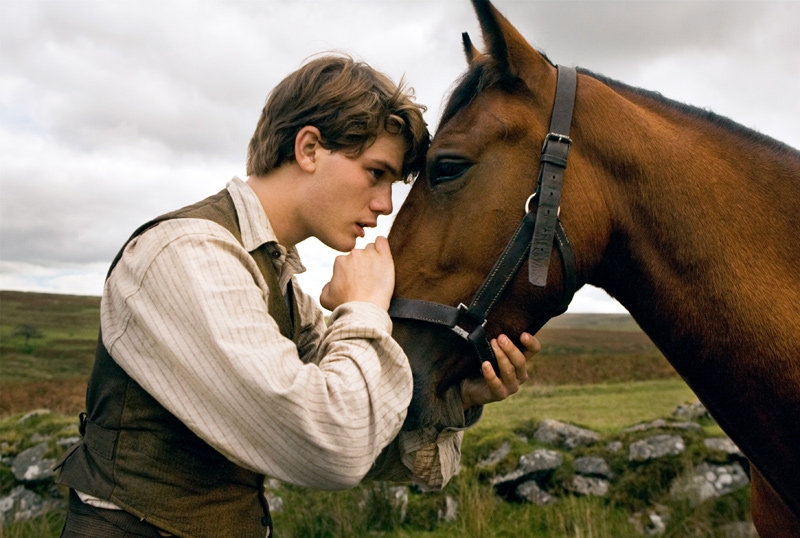

Perhaps because of the National Theatre production's innovative solution to the problem of putting horses on the stage through the use of giant puppets, it generated a fascinating documentary called Making War Horse.  The film, available on DVD, besides dealing with the story itself, stresses the creation of the puppets in collaboration with the Handspring Puppet Company and the training of the puppeteers necessary to create the illusion of lifelike horses.  Not to be outdone, the film too has generated not a documentary as of yet but an elegant "pictorial moviebook," War Horse: The Making of the Motion Picture. No puppets it's true, but more than 140 brilliant photos from the film in their place. 

Divided into three sections the book takes you on a visual journey first through the film's story, then its production and finally gives a short nod to the history of horses in warfare.  "Joey's Journey" outlines the basic plot of the movie with stills from the film, comments from the filmmakers and even an excerpt or two from the script.  There are individual photos of the large cast and brilliant shots of the British countryside.  But the really exciting visuals are those capturing the interaction of men and the horses first on the farm and then at war. 

The second section takes you behind the scenes.  While it does provide some interesting insights like the ten different horses playing the role of Joey and the shot of the makeup artist working on one of the equine actors, the whole section runs little more than a dozen pages, much of it taken up with commentary.  "The History of War Horses" uses illustrations from history to highlight the role of horses from ancient Egypt through World War 1, with the emphasis on the latter.  As history it is little more than a sketch, and at best will whet the interested reader's appetite for something more substantial.  Still this is after all a book about the making of a movie, and one can't expect a historical dissertation.

There are forewords by Spielberg, producer Kathleen Kennedy, who seems to have been the originator of the project, screenwriter Richard Curtis, and author Morpurgo.  Curtis has an interesting tidbit about how his film Four Weddings and a Funeral beat out Spielberg's Schindler's List for a French foreign film award, the kind of anecdote you can dine out on.  Morpurgo talks about the writing of the novel and somewhat fetchingly confesses his preference for cows over horses at the time he was writing.  One imagines recent developments may well have changed his mind.

If the film manages to garner the same kind of critical acclaim as the play, this is a book that may well share that popularity.  Although it is quite well done in its own right, it seems to me that its success is clearly tied directly to the success of the film.


Saturday, November 19, 2011

DVD Review: Making War Horse

This article was first published at Blogcritics

Making War Horse is a very conventional documentary about a very unconventional play.  Written, filmed and directed by David Bickerstaff and Phil Grabsky, the documentary tells the story of the multiple award winning National Theatre production from its inception to its critically acclaimed premiere.  War Horse is an adaptation of Michael Morpurgo's young adult novel dealing with the military's use of horses in WWI.  And although it was the winner of the 2011 Tony Award for best play, it is considered by many less significant as a dramatic piece than as a theatrical spectacle.  Indeed, in an interview on CUNY's Theater Talk, Nicholas Hytner, the National Theatre's artistic director, confessed some surprise that the play had received the award.  It wasn't that he wasn't happy to have won; it was simply that he seemed to agree that it was the play's spectacular staging that made it exceptional. 

It is that exceptional staging that is the central concern of Making War Horse.  The decision to use life size puppets to get not only the horses but other animals as well on stage was no doubt the crucial element in the show's success. Co-director of the production, Tom Morris, had seen the work of a South African puppet company, Handspring Puppet Company, and was looking for a vehicle in which he could utilize their puppets.  Morpurgo's novel was suggested by his mother.  It turns out mothers always know best.  If the spectacular use of puppetry is the best part of the production, the film of the puppeteers working to capture the horses' movements, three puppeteers to each horse, is the best part of the documentary.  Just as the audiences in the theater can manage to ignore the visible puppeteers as they create the illusion of galloping horses on the stage, so too can the viewer of the documentary.  Even on film the effect is breathtaking. 

All well and good, but how do you adapt a story where the main character is a horse and everything comes from that horse's point of view to the stage?  Morpurgo, himself, confesses to his own skepticism when he found out about the project.  Hytner says: "There was no question ever of the horse speaking. So, that was a challenge . . .the necessity of finding a story which put the horse at its center but which denied the horse a speaking voice."  It was left to writer Nick Stafford to turn the horse's first person account into a third person narrative.  Morpurgo explains that he used the horse's point of view because an animal would experience the horrors of war without taking sides.  Stafford also had to find a way to make this idea that war is not really good for anyone clear as well.

While the actual documentary runs a little under 50 minutes, the DVD does include over 70 minutes of bonus material.  There is a lengthy interview with Morpurgo that covers among other things his thoughts about war, his writing methods, his feelings about adaptations and his limited role in the production.  A short feature on the process of getting the play on the stage includes extensions of interviews with co-directors Morris and Marianne Elliott and writer, Stafford.  Some of the material is a repetition of what had been included in the actual documentary.  There is also a short feature on the Handspring Puppet Company which includes some interesting material on how the puppets were made, how they are maintained, and how they are operated.

A section called "Video Diaries" consists of some candid film taken by Tom OliĆ©, one of the puppeteers.  It begins with the first day of rehearsal when the cast and crew gather to introduce themselves and ends with the final curtain call before the production moves from the National to the New London.  Together with a short behind the scenes feature which silently roams around backstage they give some interesting insight into what is happening on the other side of the curtain. Finally there is a video of the puppeteers visiting an actual military horse troop to get a realistic sense of the animal's movement, a War Horse trailer and an image gallery. 

A film adaptation directed by Steven Spielberg is due in theaters in December.  The cast includes David Thewlis, Jeremy Irvine, Bernard Cumberbatch and Emily Watson—no puppets.