Showing posts with label Allen Ginsberg. Show all posts

Monday, June 18, 2012

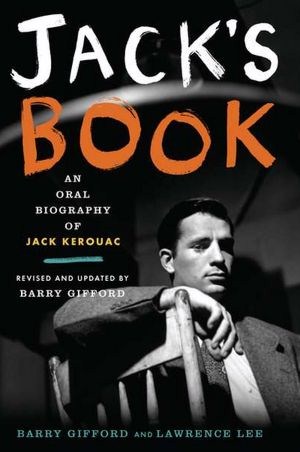
Book Review:Jack's Book: An Oral Biography of Jack Kerouac by Barry Gifford and Lawrence Lee

This article was first published at Blogcritics


Just in time for the scheduled May premiere of the first adaptation of Jack Kerouac's On the Road at the Cannes Film Festival, Penguin books is reissuing Jack's Book: An Oral Biography of Jack Kerouac by Barry Gifford and Lawrence Lee with a short new introductory essay by Gifford.  The 1978 biography combines commentary from the author's friends and lovers, the famous and the notorious, most of whom had found their way thinly disguised into Kerouac's published work under pseudonyms with connective tissue provided by Gifford and Lee.  If Kerouac's books taken altogether form one long narrative ("one vast book") of his life as he saw it (an idea he often seems to have expressed in conversation), Jack's Book creates a portrait of that life as those around him saw it.

Gifford points out that when Allen Ginsberg read the galley's of the book his first thought was: "My god it's just like Rashomon--everybody lies and the truth comes out."  The idea that people view the world subjectively and truth is relative is not particularly new, nor is the idea that something closer to the objective truth can emerge from the collection of these subjective truths.  These people all knew Kerouac, but in a very real sense they knew the Kerouac they wanted him to be.  Just as he created a mythic figure out of a womanizing, petty car thief, they created a larger than life genius tormented by demons, a dark soul too beautiful for the world. This would seem to be the collective truth that emerges from those who knew him; readers will have to come to their own conclusions.

Gifford also points out that this book not intended as a definitive biography.   Much of his life—the early days in Lowell and the last years--is covered very sketchily.  There is some conversation with his boyhood friends, but nothing in the kind of detail devoted to his arrival in New York to attend Columbia University and his friendship with Neal Cassady.  In fact, there are long passages where Cassady is really the center of attention and Kerouac almost forgotten.  To the extent that Kerouac turned Cassady into one of the iconic figures of 20th century literature the attention is certainly merited, but it does reinforce the notion that Jack's Book is something other than the last word on the life of Jack Kerouac.

What the book does best is provide insights into what a wide variety of people saw in him.  John Clellon Holmes, author of Go calls Kerouac somewhat paradoxically "a terribly simple and conventional genius."  Musician David Amram remembers Kerouac telling him "a writer should be like a shadow, just be part of the sidewalk like a shadow."Gore Vidal, obviously less taken with Kerouac talks about his bisexuality and claims he "was not above using it, and his physical charms to get his way." Ginsberg saw him as more Puritanical about his sexuality.  William Burroughs and Gregory Corso describe the way he wrote, intense periods of composition with the words seemingly pouring out of him in a Thomas Wolfe kind of rhapsody. 

Some people object to the way they were portrayed in his writing, taking the opportunity to tell their side of the story.  It is understandable considering that it has been very easy for readers to identify most of the real life models for Kerouac's characters and they are not always pleasing portraits.  His publishers were often concerned about the possibility of legal action as a result of some of the unflattering material. Interestingly, Gifford and Lee provide an appendix identifying the fictional counterparts of many of those who appear in the book for.

 Jack's Book is an impressive picture of Kerouac and his relations with those around him. He was many things to many people, but there were few who failed to be captivated by his dynamism and passion.  While it is probably true that the more familiar a reader is with Kerouac's work, the more meaningful this book will be, there will as likely be a good many  that will be led to read those books they have  yet to read as a result of meeting the man who wrote them.   The Kerouac of Jack's Book is much the dark romantic genius (simple and conventional as that might seem to some) burning as many ends of life's candle as he could manage. 

Thursday, June 17, 2010

Book Review: Just Kids, by Patti Smith

This article was first published at Blogcritics

After some cursory attention to her childhood, Patti Smith moves very quickly to the heart of her new memoir, Just Kids, with her arrival in New York City in the summer of 1967 in pursuit of the artist's life. She has no money. Friends she hoped would put her up are nowhere to be found. Some kind of job in the arts out of reach: she is reduced to living on the streets. And then she meets a young man, an artist almost as destitute as she is herself; there is an affinity right from the start. Their relationship seems to have been almost mystically fated. They pool their meager resources, and Smith begins her "vie boheme," with famed photographer, Robert Maplethorpe.

If you are looking for the story of Patti Smith's career as a rock star, Just Kids isn't where you're going to find it. While she does write something about her music, it only comes at the very end of the book, it is very sketchy at best. She tells more about Maplethorpe's photograph session for the "Horses" album cover than she does about the music itself. This memoir is focused on the period before she became famous. It talks about her poetry; it talks about her drawings, but most of all it talks about her love and friendship for the photographer.

They may have only had enough money to share a hot dog at Nathan's or grilled cheese sandwiches at a local diner, but what they did have was an intense faith in themselves as artists destined to produce work of greatness coupled with a firm belief that to produce art was perhaps man's noblest ambition. "It's the artist's responsibility," she tells us, " to balance mystical communication and the labor of creation." More often than not she talks about art and artists in religious terms. Jim Morrison is "like a West Coast Saint Sebastian." Birdland is "hallowed ground" that was "blessed by John Coltrane." Maplethorpe's "service was to art, not to church or country." She sets off for New York from her South Jersey home like a Joan of Arc in pursuit of her destined glory.

And she finds it. The late sixties in New York were filled with budding painters, musicians, poets, actors with the same kind of devotion, not to mention the bevy artistic wannabees and hangers on in pursuit of their own dreams. There were even those, poets like the Beats, artists like Andy Warhol, who had already found success. There was a ready-made community with similar values always looking for kindred souls, always willing to see greatness in the work of their friends.

Indeed, the most interesting parts of the book are the anecdotes about the great and the near great. Allen Ginsberg, thinking she's a pretty boy, buys Smith a cheese sandwich at the Automat when she is short of money. Gregory Corso, falls asleep in her arm chair while reading her poems, and burns a hole in the arm. She goes out to dinner with Sam Sheppard, not realizing he is a famous playwright. Maplethorpe takes her to meet his Catholic family and tells them they are married. She visits Jim Morrison's grave in Paris and is scolded by an old crone caretaker because Americans have no respect for their poets.

Her own prose is at times very poetic, at times somewhat pretentious. At her best she has a knack for just the right inventive image. The first man walking on the moon is putting "rubber treads on a pearl of the gods." Jim Carroll "shot stuff in his freckled hand, like the darker side of Huckleberry Finn." On the other hand she calls a Bob Dylan obsessed fan's analysis of one of his songs an "endless labyrinth of incomprehensible logic." She says Maplethorpe "sought to elevate aspects of male experience, to imbue homosexuality with mysticism." Often the high flown mystical language makes an ironic contrast to the sleaziness of the one small room they shared at the Chelsea Hotel and the second hand outfits she is constantly describing.

As memoirs go, the most impressive thing about Just Kids is its honesty. Smith's description of her life with Maplethorpe has the ring of truth. She doesn't seem to have tidied things up. Drugs, sex, poverty—they're all there. Nothing is made to look rosy: except that there were two young people and they had their art and they had each other, and for a time that was enough.